Reflections
The Power of Software
Discover the transformative power of software in shaping industries and revolutionizing our lives.
What the 2026 GPN Labor Survey means for your operation.
The 2026 Greenhouse Product News (GPN) Labor Survey confirms what growers are seeing across the industry: labor remains expensive, unpredictable, and increasingly difficult to manage.
Forty-one percent of respondents reported labor shortages. Among growers without enough labor, 18% saw harvested crops fall by 10% to 19%, and another 16% said 20% to 29% of their crops went unharvested.
Those are serious consequences. They also raise an important question: How does a grower know whether an operation truly needs more people?
Growers often tell us that when work falls behind, the instinct is to “throw an army of people at it.” More workers are pulled into the area, the immediate problem gets solved, and the operation moves on.
What often goes unanswered is why the work fell behind, and whether adding more people was the best fix.
Do You Need More People...or Better Visibility?
A late job can easily look like a labor shortage. But several different operational problems can produce the same result.
The labor plan may have been unrealistic. The crew may have started late or waited on materials, equipment, or direction. Unplanned work may have pulled people away from higher-priority tasks. Performance may vary widely between teams or locations.
Or the operation may genuinely lack the labor to get the work done.
Without data, every one of these situations leads to the same conclusion: “We need more people.”
That conclusion may be right, but it should be backed by evidence. Adding workers to a planning, deployment, or process problem raises labor costs without fixing the real constraint.
Before deciding they need more people, growers should be able to answer:
The answers separate three very different problems:
A planning or process problem: Labor standards, schedules or operating assumptions do not reflect what the work actually requires.
Each problem calls for a different response. A true capacity shortage may justify hiring, H-2A participation, overtime, automation, or changes to the production plan. A deployment problem calls for better daily visibility and coordination. A planning problem calls for stronger standards, more complete schedules, and more consistent processes.
The goal is not to prove that growers already have enough people. It is to give them enough information to know.
Rising Labor Costs Make the Distinction More Important
Even when workers are available, the cost and predictability of that labor remain major concerns.
According to the survey, 32% of respondents use H-2A, and 72% of those hire a third party to manage the process. Sixty percent said wage and legal requirements have affected their use of the program, and 29% may reduce or stop using H-2A because of rising Adverse Effect Wage Rates.
Growers described the impact plainly: labor is harder to budget, rising costs are cutting into already-thin margins, and required wages keep climbing.
No individual grower can control wage requirements, policy changes or the supply of seasonal workers. What growers can control is how each available labor hour is planned, assigned and measured.
When labor was cheaper, an operation could absorb some inefficiency. Today, unplanned work, inaccurate standards, idle time, and poor sequencing carry a much higher price.
Knowing total payroll after the week is over is no longer enough. Growers need to understand what their workforce accomplished with those hours, and where the operation can improve.
Automation Needs Labor Intelligence
The survey also found that 45% of growers plan to address labor challenges by investing in automation, an 11% increase over 2025. Irrigation and planting are the top targets, followed by fertilizing and spraying.
Physical automation can reduce repetitive work, improve consistency, and lessen dependence on hard-to-fill positions. But automation alone does not tell a grower where to invest first.
Before buying equipment, an operation should know:
Without that baseline, growers risk automating the most visible work instead of the work with the greatest financial payoff.
The strongest automation strategy starts with labor intelligence.
Where Growmentum Fits
Growmentum is the operational layer that connects a grower’s production plan, workforce, and financial results.
Instead of waiting for payroll reports to learn what labor cost, leaders can see what work was planned, what was completed, how many hours it took, and where actual performance differed from expectations.
That visibility helps growers:
Most importantly, Growmentum helps leaders determine what kind of labor problem they are actually trying to solve.
The data may confirm that more workers are needed. If so, the operation will have stronger evidence to support hiring, overtime, H-2A participation, or automation.
Or the data may reveal that the operation has enough total labor, and needs to improve how work is planned, sequenced, or assigned.
Replace Intuition with Evidence
The 2026 GPN Labor Survey shows that the industry’s labor pressure is real. It also shows why growers need a more precise understanding of labor inside their own operations.
The most important workforce question is no longer simply: Can we find enough people?
It is also: Do we truly need more people, or do we need better visibility into how our existing people and hours are being used?
Growmentum helps growers answer that question. By turning labor activity into actionable operating intelligence, Growmentum helps leaders plan with more confidence, deploy their teams more effectively, and make better decisions about where the next dollar...and the next labor hour...should go.
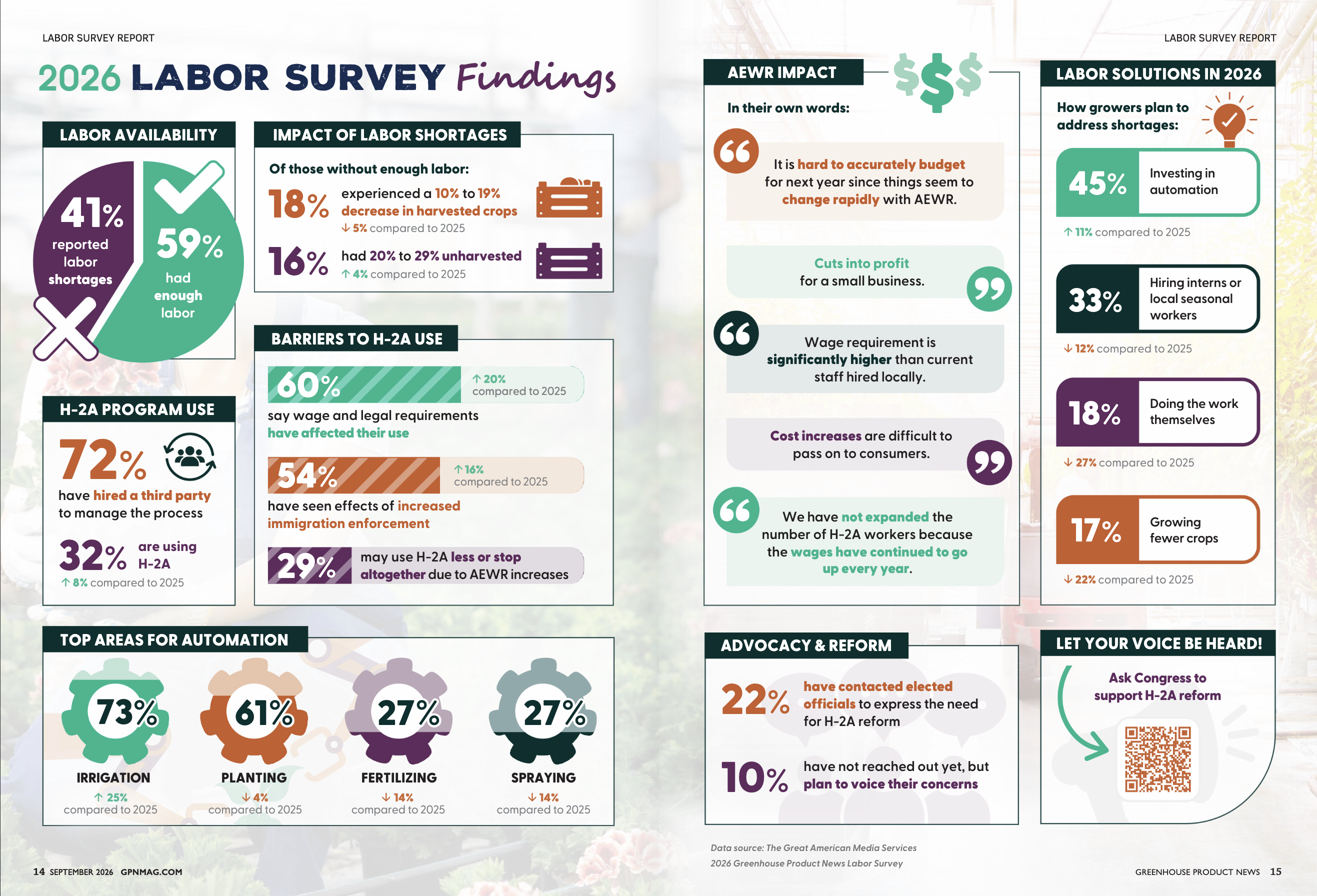
Survey findings referenced from the 2026 Greenhouse Product News Labor Survey, published by Great American Media Services.
See Where Your Labor Hours Really Go
Before you hire, add overtime, or invest in automation, get a clear picture of how your current team and hours are being used. Growmentum shows you what was planned, what got done and where the gaps are, so you can solve the right labor problem.
Ready to replace guesswork with evidence? Book a Growmentum demo or visit growmentum.io.
Discover the transformative power of software in shaping industries and revolutionizing our lives.
Discover how Growmentum empowers Executives, Growers, and Team Leaders with tools to streamline greenhouse operations and boost productivity.
Inside Metrolina’s labor governance model and how standardized work cut 100,000 hours while improving operational predictability.